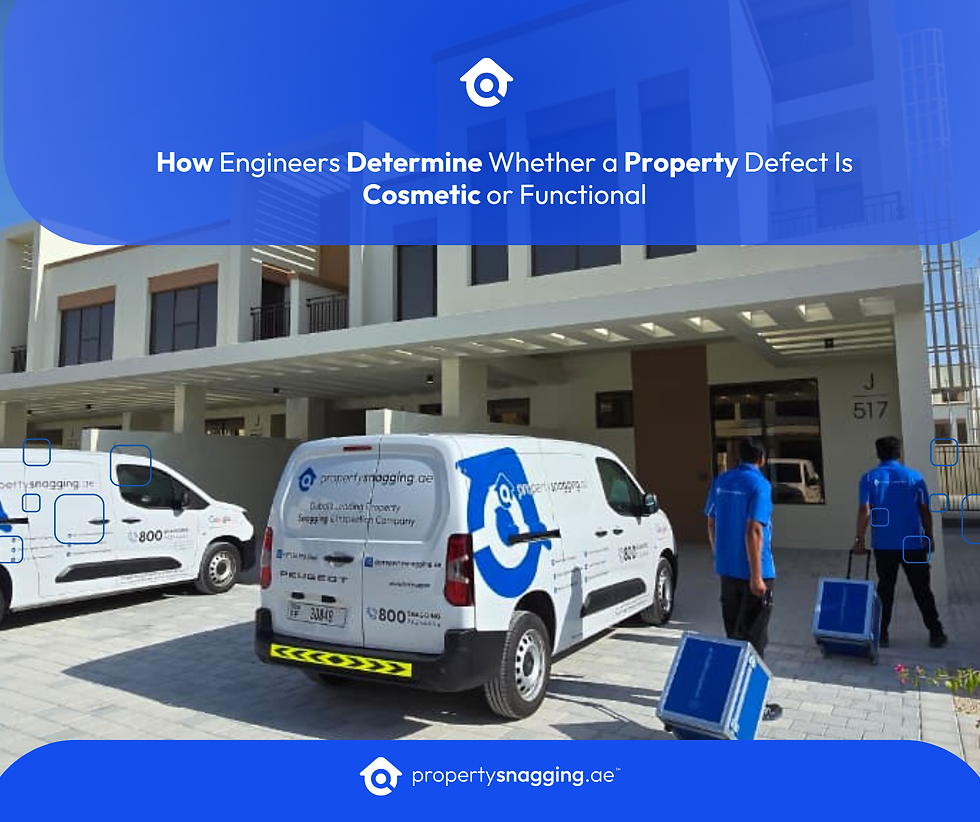
What 1,000+ Property Inspections Reveal About Construction Quality in Dubai
Property Inspections Reveal something that a property viewing rarely can: construction quality is not always visible when a home looks finished. After more than 1,000 property inspections across Dubai, one consistent lesson is that a completed property can still contain defects in workmanship, installation, finishing, waterproofing, drainage, electrical systems, doors, windows, and mechanical components.

The important point is not that every new property has serious defects. It is that construction quality needs to be tested rather than judged by appearance.
A clean handover apartment may look excellent during a five-minute viewing. A detailed inspection takes a different approach. It checks how components operate, whether finishes are properly executed, whether installations behave as expected, and whether apparently minor defects could develop into larger maintenance problems.
What Property Inspections Reveal About Construction Quality
Construction quality is not measured by how attractive a property looks on handover day.
An experienced inspector looks at the relationship between workmanship, materials, installation, functionality, tolerances, and performance.
This distinction matters because many defects are not immediately obvious. A door can look perfectly aligned until it is opened and closed repeatedly. A bathroom can appear finished while drainage performance, water sealing, or moisture conditions require closer examination. A socket may be installed neatly but still require functional testing.
Across property inspections, the recurring lesson is that visible finish and functional quality are two different things.
A professional inspection therefore moves beyond visual presentation and asks a more useful question:
Does the property actually perform as it should?
Finishing Quality Often Tells Only Part of the Story
Paint, tiles, flooring, cabinetry, silicone joints, skirting, doors and sanitary fixtures receive considerable attention during handover inspections because these are the elements owners see immediately.
They also provide useful evidence about workmanship.
Common examples include uneven paintwork, poor silicone application, damaged surfaces, inconsistent tile joints, hollow-sounding tiles, gaps around fixtures, misaligned cabinetry and doors that do not close correctly.
But a defect should not automatically be classified as serious simply because it is visible.
The inspector needs to determine whether it is cosmetic, functional, installation-related, or potentially connected to a larger underlying issue.
For example, a small gap around a wet-area fixture may look like a finishing issue. Its significance changes if water can penetrate the surrounding assembly.
This is why defect classification requires technical judgment rather than simply photographing everything that looks imperfect.
The Hidden Construction Issues Are Often More Important
Some of the most important findings during a property inspection are not immediately visible.
Waterproofing and moisture require more than a visual check
Water-related problems can develop behind finished surfaces, around bathrooms, kitchens, balconies, windows and other exposed areas.
An inspector may therefore look for visible signs of moisture, staining, deterioration, unusual readings or conditions that justify further investigation.
The objective is not to declare hidden damage without evidence. It is to identify indicators that require attention before they become expensive repair issues.
This distinction is critical when inspecting newly completed properties.
Electrical installations need functional attention
Electrical systems are another area where appearance can create false confidence.
A well-installed faceplate does not prove that the entire electrical installation is functioning correctly.
Inspection can involve checking accessible outlets, switches, fixtures, distribution-board conditions and other relevant components within the agreed inspection scope.
The same principle applies throughout the property: installation quality should be assessed through appropriate testing wherever possible, not appearance alone.
Plumbing and drainage can expose workmanship problems
Bathrooms and kitchens contain several systems that need to work together.
Fixtures may be correctly positioned while drainage performance, connections, water flow, pressure, sealing or installation quality still require attention.
A slow drain or poorly functioning fixture may appear insignificant during a quick viewing. During an inspection, however, it becomes a functional issue that should be documented and investigated.
Why the Same Defect Can Mean Different Things
One of the most important lessons from inspecting properties is that the same visible defect can have different implications depending on its location and behaviour.
A hairline crack in one area may be a finishing concern. A similar-looking crack in another location may justify further investigation.
A door gap might simply require adjustment. In another case, it may indicate alignment or installation problems.
A discoloured sealant joint might be cosmetic, while deterioration in a wet area can raise a different concern.
This is why professional property inspection should not operate from a checklist alone.
A checklist helps ensure coverage. Engineering judgment determines significance.
Construction Quality Changes Across Projects and Property Types
Dubai's residential market includes apartments, villas, townhouses, branded residences and large master-planned developments. Construction methods, contractors, finishing standards, specifications and individual project conditions can differ considerably.
For that reason, inspection findings should not automatically be treated as representative of every property within a development or every project delivered by a particular developer.
A useful inspection dataset can identify recurring patterns, but each property still needs to be assessed on its own condition.
Our broader analysis of inspection findings is explored in the [Dubai Property Defect Index], where construction-quality observations are considered across major developments rather than relying on assumptions based on appearance or reputation.
Why Handover Inspections Matter
Handover is an important point in the property's lifecycle because defects can be documented while responsibility for rectification is still being established with the relevant parties.
The purpose of a professional snagging inspection is not simply to create a long list.
A useful report should help the owner understand:
What is defective
Where the defect is located
What evidence supports the finding
Whether it affects appearance, operation, durability or performance
What action or further investigation may be appropriate
Whether the issue should be verified after rectification
Photographs are particularly important because they establish a visual record of the condition observed during inspection.
For certain conditions, additional inspection tools can provide useful evidence. Depending on the issue and accessibility, this can include moisture measurement, thermal imaging, electrical testing and other appropriate diagnostic methods.
The Cost of Construction Defects Is Not Always the Repair
A defect does not necessarily become expensive because the repair itself is expensive.
The greater risk can be the delay between discovery and rectification.
A poorly sealed area can allow deterioration to continue. A drainage problem can contribute to moisture damage. A small installation problem can become more difficult to correct once finishes, cabinetry or other components are affected.
That is why early documentation matters.
Our analysis of the financial implications is covered in [The Hidden Cost of Property Defects in Dubai], which examines why apparently minor construction defects can have consequences beyond the initial repair.
What 1,000+ Inspections Change About the Way You Inspect a Property
Experience changes the inspection process.
After examining a large number of properties, an inspector becomes less dependent on what looks unusual at first glance and more focused on how a building component should behave.
The inspection becomes a sequence of questions:
Is the installation correct?
Does the component operate properly?
Is the finish consistent with the surrounding work?
Is there evidence of moisture, movement, damage or deterioration?
Does one defect suggest that another area deserves closer examination?
Is the issue isolated, or does it appear to be part of a wider workmanship problem?
That approach produces a more useful report than simply accumulating photographs.
Our detailed review of [what we found during 1,000 property inspections across Dubai] provides further context on the practical observations that emerge when a large number of inspections are considered together.
Construction Quality Should Be Verified, Not Assumed
A property inspection cannot replace the developer's construction process, approved design, warranties or statutory responsibilities. It serves a different purpose: independently examining the condition and functionality of the accessible property at the time of inspection.
That distinction is important.
An inspection should not be used to make unsupported claims about a developer, contractor or entire development based on one property's defects.
Instead, documented inspection evidence can help an owner understand the actual condition of their individual property and communicate specific issues clearly.
This is also why inspection reports should avoid vague statements such as "poor quality" without explaining what was observed.
A stronger finding identifies the defect, records its location, provides evidence and explains why it requires attention.
From Inspection Findings to Better Property Decisions
The value of more than 1,000 inspections is not simply the number itself.
The real value comes from recognising how defects behave across different properties and learning which areas deserve closer technical attention.
That experience helps inspectors move beyond surface-level snagging.
It also changes the owner's perspective.
Instead of asking whether a property looks finished, the better question is whether the property has been properly inspected, tested and documented.
A new property can be visually impressive and still require corrective work. Conversely, a property with a number of minor cosmetic findings may not have the same functional significance as one with a smaller number of defects affecting waterproofing, drainage, electrical systems or other critical components.
The number of snags alone therefore does not define construction quality.
The type, location, evidence and functional significance of the defects matter more.
Conclusion
What Property Inspections Reveal after more than 1,000 inspections across Dubai is a simple but important principle: construction quality cannot be reliably judged from appearance alone.
Professional inspection looks at workmanship, functionality, installation quality and evidence. It separates cosmetic imperfections from defects that may affect performance or durability and identifies conditions that require further investigation.
For buyers approaching handover, the objective should not be to find the longest possible snag list. It should be to understand the actual condition of the property, document defects accurately and give the developer or contractor clear information for rectification.
If you are approaching handover or want an independent assessment of your property's condition, PropertySnagging.ae provides professional property inspection and snagging services designed to identify and document defects before they become bigger problems.
Email: hello@propertysnagging.ae
Call / WhatsApp: +971 56 790 7966
1053+ Verified 5-Star Reviews