Property Snagging Checklist Dubai: 100+ Things to Check Before Handover
A Property Snagging Checklist Dubai inspection should go far beyond checking whether walls look clean and paintwork appears finished. A newly completed apartment or villa can contain defects that are difficult to see during a normal viewing but become expensive or disruptive after handover.

A proper snagging inspection works through the property systematically, testing accessible components rather than simply looking at them. Doors are operated, sanitary fittings are checked, electrical points are tested, drainage is observed, surfaces are examined under suitable lighting, and areas vulnerable to moisture or poor workmanship receive closer attention.
The objective is simple: identify defects while the developer or contractor is still responsible for rectification.
What a Property Snagging Checklist Dubai Inspection Should Cover
A useful checklist should follow the way a building actually functions. Instead of inspecting room by room only, an experienced inspector considers the relationship between finishes, structure, plumbing, electrical systems, HVAC, drainage and waterproofing.
The following checklist covers the principal areas that should be examined before handover.
1. Entrance, Doors and Access
Start at the entrance because door problems are common and easy to overlook when a buyer is focused on finishes.
Check:
Main entrance door alignment
Door frame alignment
Door leaf movement
Hinges and fixing points
Door closing action
Lock operation
Handle operation
Door seals and gaskets
Gaps around the door
Threshold condition
Door closer, where installed
Fire-rated door condition where applicable
Internal door alignment
Internal door clearance
Door handles and locks
Bathroom door operation
Wardrobe and cabinet doors
Sliding-door movement
Balcony door operation
Door glass and frames
A door that closes but requires excessive force is not necessarily functioning correctly. Check operation repeatedly rather than judging it from one movement.
2. Walls, Ceilings and Finishes
Visual inspection remains important, but it needs to be systematic.
Look for:
Cracks
Hairline cracking around openings
Uneven plaster
Hollow-sounding areas where appropriate to test
Paint runs
Roller marks
Uneven paint coverage
Patch marks
Discolouration
Staining
Damp or moisture indications
Poor corner finishing
Damaged wall edges
Uneven ceiling surfaces
Ceiling cracks
Poorly finished service openings
Visible construction residue
Inconsistent sealant
Damaged decorative finishes
Gaps around fixtures
Not every hairline mark represents a structural problem. The important issue is to document its location, size, pattern and surrounding condition so that the appropriate rectification can be requested.
For broader evidence about defect patterns identified across Dubai properties, see the Dubai Property Defect Index.
3. Flooring, Tiles and Skirting
Floor finishes can hide defects that become obvious only after furniture is installed.
Check:
Tile cracks
Chipped tiles
Uneven tile levels
Lippage between adjacent tiles
Hollow-sounding tiles where testing is appropriate
Damaged grout
Missing grout
Uneven grout lines
Poor tile cuts around fixtures
Floor slope
Floor drainage direction
Threshold transitions
Skirting alignment
Damaged skirting
Gaps at skirting joints
Stone surface damage
Scratches
Staining
Uneven floor transitions
In wet areas, the direction of the floor slope matters. Water should move toward the intended drain rather than collecting against walls, doors or fixed fittings.
4. Kitchen and Joinery
A completed kitchen should be operated, not simply photographed.
Check:
Cabinet alignment
Cabinet-door operation
Drawer movement
Drawer runners
Hinges
Soft-close mechanisms
Cabinet internal damage
Worktop joints
Worktop scratches or chips
Splashback condition
Sink installation
Sink sealant
Tap operation
Water flow
Drainage below the sink
Water leaks under the sink
Appliance installation
Appliance connections
Extractor operation
Electrical outlets
Isolation switches where accessible
Pay particular attention to the area beneath the sink. A cabinet may look perfect while a small connection leak is already damaging the concealed joinery.
5. Bathrooms and Plumbing
Bathrooms require functional testing because several defects only become apparent when water is actually used.
Check:
Basin condition
Basin sealant
Basin tap operation
Hot and cold water operation
Water pressure at accessible outlets
Shower operation
Shower mixer
Showerhead
Bathtub condition
Toilet installation
Toilet flushing
Toilet stability
Visible plumbing connections
Waste drainage
Floor drain condition
Drainage speed
Floor slope toward drain
Silicone and sealant joints
Wall-to-floor junctions
Shower-screen installation
Shower-screen seals
Bathroom ventilation
Visible signs of water leakage
A slow drain should not automatically be dismissed as a minor issue. Combined with poor floor falls, it can result in standing water and recurring moisture problems.
6. Electrical Systems
Electrical checks should be performed carefully and within the inspector's permitted scope.
Check:
Socket condition
Socket alignment
Switch operation
Light-switch operation
Light fittings
Accessible electrical outlets
Appliance outlets
Bathroom electrical fittings
Balcony outlets where provided
Distribution-board labelling
Accessible protective devices
Visible wiring defects
Loose or damaged accessories
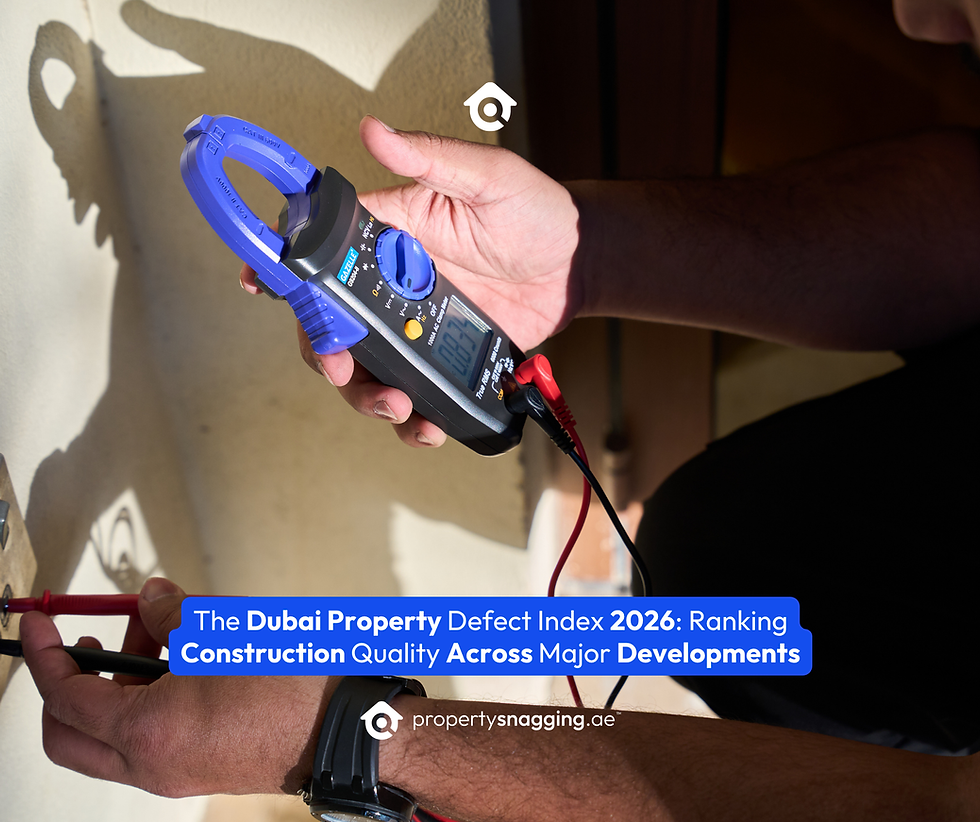
Where appropriate, professional electrical test equipment can provide information that a visual inspection cannot. A socket appearing normal does not establish that every aspect of its electrical function is satisfactory.
7. HVAC and Ventilation
Dubai's climate makes air-conditioning performance particularly important.
Check:
Air-conditioning operation
Thermostat operation
Supply-air outlets
Return-air grilles
Airflow from accessible outlets
Unusual noise or vibration
Visible condensation
Accessible drain lines
Signs of water around HVAC equipment
Grille alignment
Damaged insulation where visible
Ventilation performance in bathrooms
Temperature alone is not always enough to diagnose an HVAC problem. An inspector should consider airflow, operating behaviour, visible condensation and accessible components together.
8. Windows, Glazing and Balconies
Windows are particularly important for air leakage, water penetration and operational problems.
Check:
Window opening
Window closing
Locking mechanisms
Frame alignment
Glass damage
Scratches
Seal condition
Silicone joints
Gaps around frames
Sliding mechanisms
Balcony door seals
Balcony floor condition
Balcony drainage
Visible waterproofing concerns
Railing condition
Railing fixings where accessible
External-facing areas should receive careful attention because defects can be exposed to wind, rain, heat and water movement.
9. Waterproofing and Moisture Risk
Waterproofing defects are among the issues that can become substantially more disruptive after occupancy.
Look for:
Moisture staining
Damp patches
Damaged sealant
Failed silicone joints
Gaps around sanitary fixtures
Poor shower-area transitions
Water accumulation
Incorrect floor falls
Signs of leakage beneath plumbing fixtures
Moisture around HVAC drainage
Water marks near windows and external doors
Where appropriate, moisture meters or thermal imaging equipment can provide additional evidence. These tools do not replace professional diagnosis; they help identify areas requiring closer investigation.
The financial consequences of apparently small defects can increase after finishes, furniture and belongings are installed. Our analysis of the hidden cost of property defects in Dubai explains why early identification matters.
10. External Areas, Utility Spaces and Less Obvious Locations
Do not stop the inspection once the main rooms look acceptable.
Also check:
Utility cupboards
Storage rooms
Laundry areas
Service doors
Accessible ceiling areas
Mechanical equipment areas
External walls where accessible
Balcony drainage
Terrace finishes
Service penetrations
Accessible pipework
Visible insulation
Floor drains
Access panels
Sealant around penetrations
These locations are often less visually attractive than living areas, which makes them easier to overlook during a buyer's walkthrough.
Why a Checklist Alone Is Not Enough
A 100-item checklist creates structure, but it does not automatically create a good inspection.
The important distinction is between looking at a component and testing its function.
A buyer may see a bathroom tap and confirm that it is installed. An inspector should consider whether it operates correctly, whether water flow is appropriate, whether the connection shows leakage and whether drainage behaves as expected.
The same principle applies throughout the property.
A professional inspection should document defects with a clear location, description, supporting photographs and, where relevant, measurements or test observations. This makes the snagging report more useful when defects are submitted for rectification.
Our article covering findings from 1,000 property inspections across Dubai provides further context on why systematic inspection matters.
When Should You Use a Property Snagging Checklist Dubai?
The most useful opportunity is before accepting the property as fully completed and before defects become harder to access.
For new-build properties, the inspection should be planned around the developer's handover process and the condition in which the property is made available for inspection.
If defects are discovered, document them clearly and submit them through the developer's established rectification process. After repairs, a de-snagging inspection can be used to verify whether the reported issues were actually corrected rather than simply marked as completed.
What Happens When Snagging Is Skipped?
Skipping a professional inspection does not mean a property has no defects. It means defects may remain undocumented.
Once furniture, appliances and personal belongings are installed, access becomes more difficult. Some problems may also only become apparent after repeated use or exposure to water, heat and normal building operation.
This is why the purpose of a snagging inspection is not to make a new property look perfect. It is to identify workmanship, installation, finishing and functional issues while they can still be investigated and rectified.
Build the Inspection Around Evidence
The strongest Property Snagging Checklist Dubai is not simply a long list of items to tick.
It is a structured inspection process that asks three questions:
Is the component present?
Is it installed and finished correctly?
Does it function as intended?
That distinction is particularly important in Dubai's new-build properties, where an apparently finished apartment can still contain defects across multiple trades.
A disciplined inspection covering structure and finishes, joinery, plumbing, drainage, electrical systems, HVAC, glazing, waterproofing and external areas gives the owner a much clearer picture before handover.
For additional Dubai snagging guidance and inspection resources, visit the Property Snagging Dubai blog.
Conclusion
A Property Snagging Checklist Dubai should be treated as an inspection framework, not just a list of cosmetic imperfections. The most important defects are not always the ones that are immediately visible. Drainage performance, water leaks, electrical functionality, HVAC behaviour, floor falls, sealant, moisture and installation quality can all require deliberate testing.
Before handover, a systematic inspection gives the owner an opportunity to identify defects, create evidence and request rectification while the property is still accessible and unfinished.
If you want your apartment or villa assessed systematically rather than relying on a quick visual walkthrough, PropertySnagging.ae provides professional property inspection and snagging services in Dubai.
Contact
+971 56 790 7966
1063+ Verified 5-Star Reviews