Today We’re Inspecting a Property in Dubai Hills Estate: A Real Handover Inspection
A handover inspection is not simply a walk around a new property to see whether it looks finished. In Dubai Hills Estate, where buyers are taking possession of apartments and villas finished to a high standard, the difference between a visual walkthrough and a professional inspection can be significant.
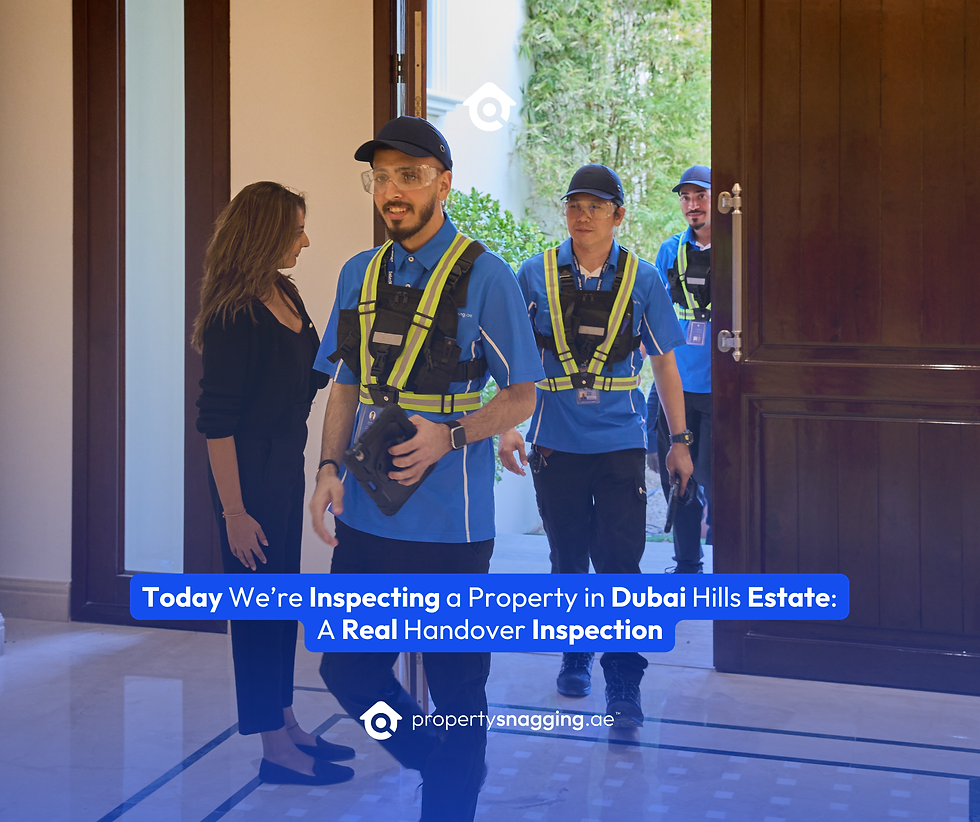
Today, we are looking at what actually happens when an engineer inspects a property before handover in Dubai Hills Estate.
The objective is straightforward: identify defects, test accessible systems, document the condition of the property and give the owner a clear record of anything that needs to be corrected before or after handover.
A newly completed property can look excellent at first glance and still have problems with drainage, air conditioning, electrical points, doors, windows, waterproofing, tiling or finishing quality.
That is why the inspection needs to go beyond what the eye notices during a developer's handover appointment.
What a Handover Inspection Actually Means in Dubai Hills Estate
A professional handover inspection is an independent technical assessment of the property's accessible components and finishes before the buyer takes full possession.
The inspection is not intended to replace the developer's completion procedures or statutory approvals. Instead, it provides the buyer with another layer of quality control.
Dubai's regulatory framework includes the Dubai Building Code and other building regulations covering areas such as safety, building design and construction requirements. Dubai Municipality states that the Dubai Building Code establishes minimum requirements relating to health, safety, welfare and building performance.
For a buyer, the practical question is different:
Does the property that I am about to accept actually perform and finish as it should?
That question drives the inspection.
Why Handover Inspection Matters More Than a Visual Walkthrough
A property viewing is largely visual. A handover inspection is investigative.
An inspector does not simply look at a wall and decide that the wall appears acceptable. The engineer considers the workmanship, alignment, finish, operation and functionality of the relevant component.
For example, a bathroom may look completely finished while the inspection reveals:
Poor silicone application around sanitary fixtures
Incorrect drainage falls
Slow drainage
Loose fittings
Water leakage beneath a basin
Damaged tiles or inconsistent grout
Inadequate sealing around wet areas
The same principle applies throughout the property.
A socket needs to be tested rather than simply observed. A door needs to be opened, closed and checked for alignment. Air conditioning needs to be operated. Water outlets and drainage points need to be assessed.
That is where the value of professional inspection becomes clear.
How We Approach a Handover Inspection in Dubai Hills Estate
The inspection starts before the engineer begins testing individual components.
The property type, layout, specifications and accessible areas are considered first. Apartments, villas and larger residences can have very different inspection requirements.
The engineer then works systematically through the property rather than moving randomly from room to room.
Handover Inspection Starts With Architectural Finishes
Walls, ceilings and floors are among the first areas that receive detailed attention.
The engineer looks for workmanship issues such as uneven surfaces, paint defects, cracks, damaged finishes, poor joints and inconsistent workmanship.
Flooring receives particular attention.
Tiles can appear visually acceptable from standing height but may have chipped edges, hollow areas, lipping or poor grout work. In premium properties, small finishing defects can be surprisingly noticeable once furniture and lighting are installed.
Doors and windows are also checked for alignment, operation, locking, handles, seals and general finishing.
Cabinetry and wardrobes are assessed in the same way. Hinges, drawers, handles, alignment and closing mechanisms all form part of the inspection.
The purpose is not to create a report filled with cosmetic complaints. The purpose is to distinguish genuine workmanship defects from normal construction tolerances and identify issues that should reasonably be addressed.
The MEP Inspection Is Where Many Problems Become Visible
Mechanical, electrical and plumbing systems require functional testing.
This is one of the most important differences between a professional inspection and a simple property viewing.
Electrical Checks During a Handover Inspection
The engineer checks accessible electrical points and confirms that installed components operate as expected.
Depending on the property and accessible systems, this can include sockets, switches, lighting, distribution-board labelling and other installed electrical accessories.
A property may have beautiful lighting and finishes, but one defective socket or incorrectly functioning switch can still become an inconvenience after move-in.
The inspection creates a record while the property is still within the developer's handover and defect-management process.
Plumbing, Water and Drainage Testing
Water systems need to be tested rather than assumed to be working.
The engineer checks accessible taps, sanitary fixtures, water flow and drainage. Areas beneath sinks and around plumbing connections are also important because small leaks can remain unnoticed during a quick viewing.
Drainage deserves particular attention.
A drain that empties slowly may not look like a major defect during a five-minute viewing, but repeated use can reveal a problem with the drainage installation or fall.
Bathrooms, kitchens, balconies and utility areas therefore receive careful attention.
HVAC and Air Conditioning
Dubai properties depend heavily on air conditioning, making HVAC performance an important part of the inspection.
The engineer checks accessible AC operation, controls, airflow and visible installation conditions.
The objective is not simply to confirm that the AC switches on.
Performance, airflow, unusual noise, condensation and other visible or operational indicators can reveal issues that should be investigated before the owner settles into the property.
Dubai's building requirements also address energy and building-performance considerations, including insulation and AC-related calculations.
Waterproofing and Moisture: The Defects You Do Not Want to Discover Later
Some of the most expensive property problems are not necessarily the most visible ones.
Moisture is a good example.
An inspector looks for visible evidence of water ingress, staining, damaged sealants, moisture-related deterioration and other indicators around bathrooms, wet areas, windows, balconies and relevant external interfaces.
Where appropriate and where the inspection scope permits, moisture-measuring equipment can provide additional information.
This matters because water-related defects can become progressively more expensive once finishes, cabinetry and flooring are installed or occupied.
A defect found before handover is much easier to document and raise with the responsible party than a problem discovered months later after the property has been furnished.
Dubai Land Department information also confirms the importance of defect protection in the development process. Its guidance states that 5% of the amount paid into an escrow account is retained for one year after project completion as a guarantee relating to defects that are apparent upon completion or emerge within one year after handover.
That does not mean an owner should wait for a defect to appear.
The smarter approach is to document the property's condition as early as possible.
What We Look For Outside the Main Living Areas
A professional inspection should not stop at the living room, kitchen and bedrooms.
Depending on the property, the inspection can extend to balconies, terraces, utility areas, external doors, accessible external finishes, drainage points and other relevant areas.
For villas in Dubai Hills Estate, the inspection scope can be considerably larger than for an apartment because there are more systems, surfaces and external interfaces to assess.
This is also where inspection discipline becomes important.
An engineer should not rush simply because the property looks new.
The Dubai Building Code and Dubai Municipality's wider building regulations provide the technical and regulatory framework for construction in Dubai. The inspection itself translates that technical perspective into practical observations for the property owner.
What Happens When Defects Are Found?
Finding defects is only half of the process.
The findings need to be documented clearly enough that the developer, contractor or maintenance team can understand what requires attention.
Photographic evidence is particularly useful because it creates a visual record of the exact location and condition of the defect.
The report should also separate observations logically. A damaged tile, a leaking pipe connection and an AC performance issue are different types of defects and should not simply be listed together without context.
This is where inspection experience matters.
A professional report should help the property owner answer three practical questions:
Where is the defect? What is wrong with it? What needs to happen next?
Why Dubai Hills Estate Properties Still Need Independent Inspection
Dubai Hills Estate has a premium reputation, but the reputation of a development should never replace technical inspection.
A new property is still the product of multiple trades, contractors, materials, installations and finishing processes.
The more complex the property, the more opportunities there are for small defects to appear.
Our broader inspection data and observations across Dubai are discussed in the Dubai Property Defect Index 2026, while our analysis of the financial consequences of unresolved defects is covered in The Hidden Cost of Property Defects in Dubai 2026.
We have also documented broader findings from 1,000 property inspections across Dubai.
The pattern is consistent: a property can look excellent and still require a detailed technical inspection.
When Should You Arrange a Handover Inspection?
Ideally, the inspection should be arranged before the developer's final handover appointment, leaving enough time for significant defects to be reported and, where possible, rectified.
If the inspection takes place after handover, it can still be valuable.
Post-handover inspections can establish a detailed condition record and identify defects that become apparent during occupation.
The important point is not to treat the developer's walkthrough as your only inspection.
A handover appointment is part of the ownership process. An independent inspection is a quality-control exercise.
The Real Value of a Professional Handover Inspection
The real value is not the number of defects written in a report.
It is the quality of the defects identified, the evidence supporting them and the ability to distinguish a genuine construction or workmanship issue from something that is simply a matter of preference.
A good inspector knows that not every mark requires escalation.
They also know that a small-looking defect can sometimes indicate a much larger underlying problem.
That judgement comes from experience.
For a Dubai Hills Estate buyer, the objective should therefore be simple: accept the property with a clear understanding of its actual condition rather than relying only on how impressive it looks during the first walkthrough.
Conclusion
A handover inspection in Dubai Hills Estate is an important technical checkpoint before taking possession of a newly completed property.
The inspection should cover far more than paint and visible finishes. Architectural workmanship, doors and windows, electrical systems, plumbing, drainage, HVAC, moisture, waterproofing, kitchens, bathrooms and accessible external areas all deserve appropriate attention.
A premium property deserves a premium level of scrutiny.
If you are approaching handover in Dubai Hills Estate, do not wait until you have moved furniture into the property to discover defects. Arrange an independent inspection while there is still an opportunity to document the condition properly and raise issues through the appropriate channels.
For professional property snagging and handover inspection services across Dubai, visit PropertySnagging.ae or explore our Dubai property snagging blog for more technical inspection guidance.
📞 +971 56 790 7966
⭐ 1041+ Verified 5-Star Reviews


