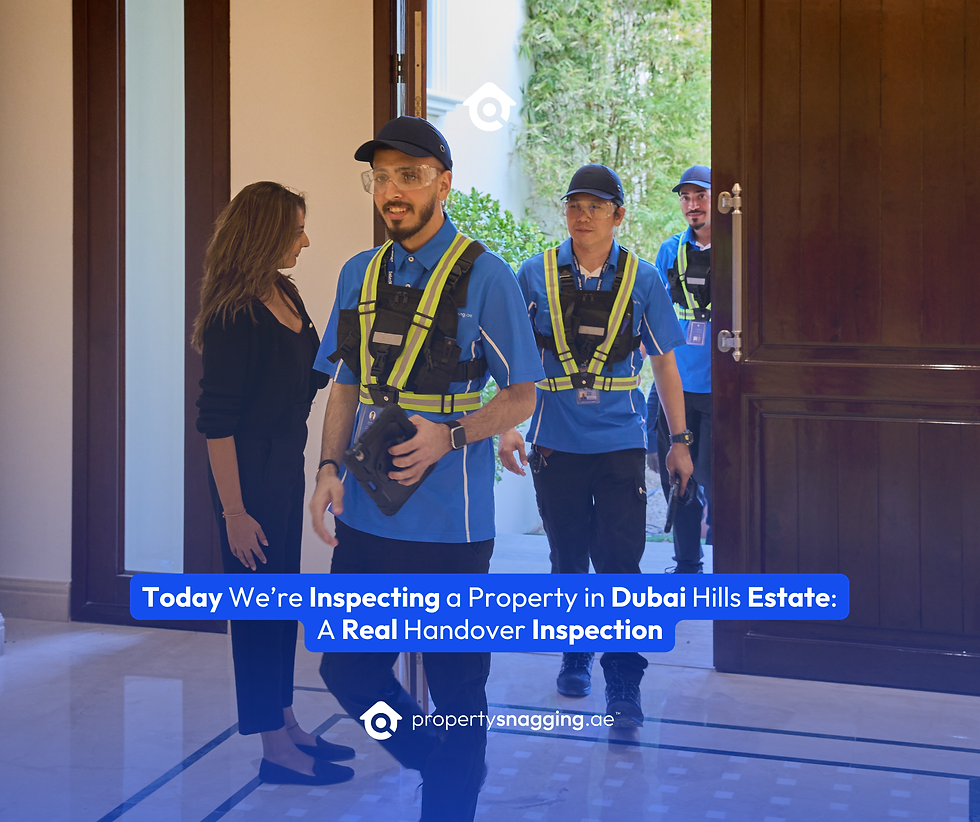
Today We’re Inspecting an Emaar Beachfront Property What We Check Before Handover
Walking into a newly completed beachfront apartment can make everything look finished. The flooring is clean, the kitchen is installed, the bathrooms are fitted, the balcony has a sea view, and the apartment may appear ready for its owner.
But inspecting an Emaar Beachfront property is not about deciding whether the apartment looks good.

It is about checking whether the property has actually been completed to an acceptable construction and finishing standard, whether its installed systems function correctly, and whether defects are documented before the owner accepts handover.
That difference matters.
At PropertySnagging.ae, our engineers approach a handover inspection as a technical examination rather than a simple viewing. A small alignment issue, poor sealant joint,
damaged finish or drainage problem may appear insignificant during a viewing but become expensive or difficult to correct after furniture, appliances and personal belongings move in.
Today, we are looking at what our inspection process focuses on when examining an Emaar Beachfront property before handover.
What Inspecting an Emaar Beachfront Property Actually Means
A professional handover inspection covers considerably more than visible cosmetic defects.
The engineer assesses the apartment systematically, moving through the property and testing accessible elements rather than simply walking from room to room.
In a premium waterfront development, expectations are naturally high. However, a high-value apartment can still contain construction defects. The purchase price or quality of the development does not remove the need for an independent inspection.
Our inspection normally considers:
Architectural and finishing quality
Walls, ceilings and flooring
Doors, frames, handles and locks
Windows, glazing and balcony doors
Kitchen cabinets, worktops and appliances where accessible
Bathroom fixtures and sanitaryware
Water supply and drainage
Electrical outlets, switches and lighting
Air-conditioning and HVAC operation
Waterproofing indicators and moisture
Balcony finishes and drainage
Sealant, silicone and expansion joints
Functional operation of installed systems
Visible defects around mechanical and service areas
The important point is that defects are not judged only by appearance.
A door that looks perfectly finished may not close correctly. A bathroom may look immaculate while its drainage is slow. An air-conditioning system may be operating while one area of the room remains inadequately cooled.
That is why a proper handover inspection requires testing.
Handover Inspection Starts With the Building, Not Just the Apartment
One common mistake is treating the apartment as an isolated product.
The engineer needs to understand how the apartment's construction and installed systems interact. External conditions, balcony drainage, glazing, waterproofing details and MEP installations can all affect the property's long-term performance.
For example, water management deserves particular attention in a coastal apartment. The balcony may look perfectly finished, but the drainage points, falls, thresholds and sealant details still need to be examined.
The objective is not to predict a future leak. It is to identify visible conditions or functional problems that could contribute to one.
This distinction makes an inspection more useful and technically defensible.
What Our Engineer Checks Inside the Emaar Beachfront Apartment
Once inside the apartment, the inspection becomes highly detailed.
The engineer works systematically rather than relying on a quick visual scan. Every room provides different opportunities for defects, and certain areas deserve more attention than others.
Inspecting an Emaar Beachfront Property Room by Room
In living and dining areas, we examine the quality and condition of flooring, skirting, walls, ceilings, doors, windows, glazing and visible finishing.
Flooring is checked for damage, hollow-sounding areas where appropriate, uneven transitions, chipped edges and poor finishing. Walls and ceilings are examined for cracks, marks, inconsistent finishing and other visible abnormalities.
Windows and balcony doors receive particular attention in a waterfront property.
The engineer checks operation, locks, handles, alignment and visible sealing. Where accessible, the surrounding frames and finishes are examined for damage or incomplete work.
In bedrooms, the same principle applies, but additional attention is given to wardrobes, internal doors, flooring transitions, sockets, switches and lighting points.
Kitchens require a different inspection approach.
Cabinet doors and drawers should operate correctly and align properly. Worktops, splashbacks, joints and exposed finishes are examined for damage or incomplete installation. Where appliances are installed and accessible, their basic operation can also be checked.
Bathrooms are among the most important areas of the inspection.
The engineer examines sanitaryware, taps, shower fittings, mirrors, accessories, cabinetry, tiles, grout, sealant and drainage. Water flow and drainage performance are particularly important because defects in these areas may not be obvious during a normal property viewing.
🚿 A bathroom that looks perfect in photographs can still have a drainage or installation problem.
Electrical, Plumbing and HVAC Testing During Handover
The decorative finish gets most of the attention during property viewings, but the systems behind the finishes are what make the apartment functional.
A professional handover inspection therefore needs to examine accessible MEP components.
Handover Inspection of Electrical and HVAC Systems
Electrical testing can include accessible sockets, switches, lighting points and other installed electrical components.
The purpose is not simply to confirm that a light turns on. The engineer looks for abnormal operation, damaged accessories, loose fittings, incorrect installation indicators and other observable issues.
HVAC is equally important in Dubai.
The apartment may have excellent finishes, but if the air-conditioning system is not performing correctly, the problem can affect comfort from the first day of occupancy.
The engineer checks accessible AC operation and looks for issues such as unusual noise, inadequate cooling, visible condensation concerns and problems with accessible controls or diffusers.
Plumbing requires practical testing as well.
Water should flow properly from accessible fixtures, while drainage should perform without obvious backup, abnormal delay or leakage.
These tests are particularly valuable because some defects only reveal themselves when a system is actually used.
A handover inspection should therefore answer a simple question: Does the property merely look complete, or does it function as a completed property?
Waterproofing, Moisture and Balcony Inspection
A beachfront apartment has characteristics that make external interfaces especially important.
Balconies, terraces, windows and wet areas are all locations where water management deserves careful attention.
Inspecting an Emaar Beachfront Property for Water-Related Defects
Our engineers look for visible signs that may indicate moisture intrusion, poor sealing, incomplete waterproofing-related finishing or drainage problems.
This can include examining:
Balcony drainage and visible falls
Thresholds around balcony doors
Sealant around windows and external interfaces
Bathroom floors and wet-area finishes
Visible moisture indicators
Ceiling and wall surfaces for staining
Pipe connections and accessible plumbing points
Silicone and grout condition
Areas where different materials meet
Moisture detection equipment can be useful when conditions justify further investigation.
However, professional inspection is not about pointing a thermal or moisture meter at every wall and declaring a problem. Instrument readings need to be interpreted alongside visible conditions, building configuration and the engineer's experience.
That is an important distinction between technical inspection and gadget-based marketing.
Our broader inspection data has also shown why seemingly minor defects deserve documentation. Property owners often focus on large visible construction problems while overlooking dozens of smaller defects that collectively affect the quality of the finished property.
Our Dubai Property Defect Index 2026 examines defect patterns across major Dubai developments and provides wider context for understanding construction quality.
Why Small Defects Should Be Reported Before Handover
One of the biggest misconceptions about snagging is that only expensive or serious defects are worth reporting.
That is not how a professional inspection should work.
A scratched cabinet panel may not be structurally important, but it is still a defect if the owner is receiving a newly completed property.
Likewise, a poorly finished silicone joint may appear insignificant. Yet if it is located around a wet area or external opening, documenting it before handover is sensible.
The timing matters because access becomes more complicated once the apartment is occupied.
Furniture can cover walls and flooring. Personal belongings can obstruct service areas. Contractors may need additional coordination to enter the apartment. A defect that could have been addressed easily before occupancy may become a disruption later.
Our analysis of inspection work across Dubai explores this issue in greater detail in The Hidden Cost of Property Defects in Dubai 2026.
What Makes a Professional Handover Inspection Different?
A handover inspection is not simply a longer property viewing.
A viewing is primarily about the buyer understanding the property.
An inspection is about assessing the condition and functionality of the property.
That means the inspector needs to know what to look for, what to test, how different building elements interact and how to document findings clearly.
The report is also important.
A useful snagging report should allow the owner and developer's representatives to understand exactly where the issue is, what has been observed and what corrective action is required.
Vague comments such as "wall problem" or "bathroom issue" provide little value.
A professional report should identify the relevant location and describe the defect sufficiently for the responsible party to investigate and rectify it.
This becomes particularly important when a property contains numerous individual findings.
Our experience across Dubai has demonstrated that systematic documentation is one of the most important parts of the snagging process. We discuss broader findings from more than 1,000 inspections in What We Found in 1,000 Property Inspections Across Dubai.
When Should You Arrange an Emaar Beachfront Handover Inspection?
The best time is generally before accepting the property and before the apartment becomes heavily occupied.
Owners should coordinate the inspection around the developer's handover process and ensure that reasonable access is available to the areas and systems that need to be examined.
The exact timing can depend on the property's handover status, access arrangements and developer procedures.
It is also important not to confuse a developer's own quality-control process with an independent inspection.
The developer has its own obligations and procedures. An independent inspector provides another technical perspective on the condition of the property from the owner's side.
That independent assessment can be particularly valuable for buyers who do not have construction or building-services expertise.
The Cost of Ignoring Defects Can Be Greater Than the Cost of Finding Them
The value of snagging is not measured by the number of defects in a report.
It is measured by the problems identified early enough to be corrected.
Some findings are purely cosmetic. Others can affect functionality, durability, water management or the owner's future maintenance costs.
The difficult part for a homeowner is often knowing which is which.
A professional inspector brings technical judgement to that decision.
That is why the objective is not to create the longest possible report. It is to create an accurate report that distinguishes genuine defects from normal construction characteristics and gives the owner useful information for the handover process.
For owners researching Dubai property inspections, our Property Snagging Dubai Blog contains additional technical guidance on snagging, handover inspections, defects and post-handover issues.
A Real Handover Inspection Is About Evidence, Not Assumptions
When we inspect a property, we are not there to judge the developer from the appearance of the apartment.
We are there to examine what is actually in front of us.
If a door is misaligned, it should be documented.
If drainage does not perform correctly, it should be recorded.
If a finish is damaged, it should be photographed.
If an accessible electrical component does not function as expected, it should be identified.
If there is a potential moisture concern, it should be investigated within the limits of the inspection.
That evidence gives the owner something practical to work with during the handover process.
Professional inspection should also remain within the limits of what can reasonably be verified. An inspector should never claim to have confirmed concealed defects simply because an instrument produced an unusual reading. Good inspection work is evidence-led.
That approach is consistent with the principles of professional property inspection and can be informed by recognised technical standards and guidance, including applicable Dubai regulations, RERA requirements, Dubai Municipality requirements, InterNACHI inspection principles and relevant building-code references where appropriate.
Why an Independent Inspection Matters for a Premium Beachfront Property
An Emaar Beachfront apartment is a significant investment. The premium location, views, finishes and amenities may create the impression that very little could be wrong.
Our experience tells us to approach the property differently.
The more valuable the property, the more important it is to establish its condition accurately before handover.
A professional handover inspection gives the owner an opportunity to identify defects while the property is still in the developer's handover and rectification process.
That is the real purpose of inspecting an Emaar Beachfront property.
It is not about finding faults for the sake of finding faults. It is about making sure that when the keys are finally handed over, the owner has a clear understanding of the property's condition and a properly documented record of anything that requires attention.
Inspecting an Emaar Beachfront Property Before You Accept the Keys
A beautiful apartment deserves more than a beautiful viewing.
Before you accept handover, have the property examined by an experienced inspection team that understands Dubai construction, MEP systems, finishes, waterproofing, drainage and the practical realities of developer handover.
If you are approaching handover at Emaar Beachfront, PropertySnagging.ae can arrange a professional inspection and provide a detailed snagging report identifying the defects that require attention.
📞 +971 56 790 7966
⭐ 1041+ Verified 5-Star Reviews